Showing posts with label student Corner. Show all posts
Showing posts with label student Corner. Show all posts
Thursday, 28 May 2009
ECO-DRIVING

Being a good driver is no more the sole criterion for getting a driving license… at least not in Britain. One has to show that he or she can be environment-friendly too by simply using fuel effectively. The British government has declared that from now fuel efficiency of teh vehicle would be made part of the driving test to help reduce polluting emissions, and to save money on energy bills.


Agropedia

Indian scientists have created an ‘agricultural Wikipedia’ to act as an online repository of agricultural information in the country. It would disseminate crop and region-specific information to researchers, students, farmers and agricultural extension workers, who share the knowledge with farmers. The site also has blogs and other platforms. The website currently contains information on nine crops — rice, wheat, chickpea, pigeon pea, vegetable pea, lychee, sugarcane, groundnut and sorghum. More topics will be added soon, after being validated through review and analysis by invited agricultural researchers. “It is hoped that even where farmers have no access to the Internet, the Agropedia information can be used as a basis for radio plays, for example,” says V. Balaji, head of knowledge management and sharing with the International Crop Research Institute for the Semi-Arid Tropics (ICRISAT), a partner in the project.
Ghg satellite

Japan has launched the world’s first greenhouse gas monitoring satellite into space. It is called Ibuki, which means ‘breath’. It will circle the planet every 100 minutes, gathering data to be shared with space and scientific organisations. It has three major mission objectives – to monitor the density of greenhouse gases precisely and frequently; to study the absorption and emission levels of greenhouse gases per continent or large country over a certain period of time; to establish advanced technologies essential for precise greenhouse gas observations. “The satellite is expected to play an important role in monitoring global environmental changes and look out for any small warning signs that could affect our future,” says a statement released by Japan Aerospace Exploration Agency (JAXA).
Sunday, 8 February 2009

solar eclipse
The Moon's Two Shadows
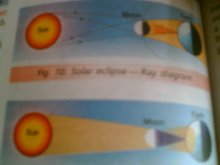
An eclipse of the Sun (or solar eclipse) can only occur at New Moon when the Moon passes between Earth and Sun. If the Moon's shadow happens to fall upon Earth's surface at that time, we see some portion of the Sun's disk covered or 'eclipsed' by the Moon. Since New Moon occurs every 29 1/2 days, you might think that we should have a solar eclipse about once a month. Unfortunately, this doesn't happen because the Moon's orbit around Earth is tilted 5 degrees to Earth's orbit around the Sun. As a result, the Moon's shadow usually misses Earth as it passes above or below our planet at New Moon. At least twice a year, the geometry lines up just right so that some part of the Moon's shadow falls on Earth's surface and an eclipse of the Sun is seen from that region.
The Moon's shadow actually has two parts:
1. Penumbra
The Moon's faint outer shadow.
Partial solar eclipses are visible from within the penumbral shadow.
2. Umbra
The Moon's dark inner shadow.
Total solar eclipses are visible from within the umbral shadow.
When the Moon's penumbral shadow strikes Earth, we see a partial eclipse of the Sun from that region. Partial eclipses are dangerous to look at because the un-eclipsed part of the Sun is still very bright. You must use special filters or a home-made pinhole projector to safely watch a partial eclipse of the Sun (see: Observing Solar Eclipses Safely).
What is the difference between a solar eclipse and a lunar eclipse? A lunar eclipse is an eclipse of the Moon rather than the Sun. It happens when the Moon passes through Earth's shadow. This is only possible when the Moon is in the Full Moon phase.
An eclipse of the Sun (or solar eclipse) can only occur at New Moon when the Moon passes between Earth and Sun. If the Moon's shadow happens to fall upon Earth's surface at that time, we see some portion of the Sun's disk covered or 'eclipsed' by the Moon. Since New Moon occurs every 29 1/2 days, you might think that we should have a solar eclipse about once a month. Unfortunately, this doesn't happen because the Moon's orbit around Earth is tilted 5 degrees to Earth's orbit around the Sun. As a result, the Moon's shadow usually misses Earth as it passes above or below our planet at New Moon. At least twice a year, the geometry lines up just right so that some part of the Moon's shadow falls on Earth's surface and an eclipse of the Sun is seen from that region.
The Moon's shadow actually has two parts:
1. Penumbra
The Moon's faint outer shadow.
Partial solar eclipses are visible from within the penumbral shadow.
2. Umbra
The Moon's dark inner shadow.
Total solar eclipses are visible from within the umbral shadow.
When the Moon's penumbral shadow strikes Earth, we see a partial eclipse of the Sun from that region. Partial eclipses are dangerous to look at because the un-eclipsed part of the Sun is still very bright. You must use special filters or a home-made pinhole projector to safely watch a partial eclipse of the Sun (see: Observing Solar Eclipses Safely).
What is the difference between a solar eclipse and a lunar eclipse? A lunar eclipse is an eclipse of the Moon rather than the Sun. It happens when the Moon passes through Earth's shadow. This is only possible when the Moon is in the Full Moon phase.
The Moon's Two Shadows
An eclipse of the Sun (or solar eclipse) can only occur at New Moon when the Moon passes between Earth and Sun. If the Moon's shadow happens to fall upon Earth's surface at that time, we see some portion of the Sun's disk covered or 'eclipsed' by the Moon. Since New Moon occurs every 29 1/2 days, you might think that we should have a solar eclipse about once a month. Unfortunately, this doesn't happen because the Moon's orbit around Earth is tilted 5 degrees to Earth's orbit around the Sun. As a result, the Moon's shadow usually misses Earth as it passes above or below our planet at New Moon. At least twice a year, the geometry lines up just right so that some part of the Moon's shadow falls on Earth's surface and an eclipse of the Sun is seen from that region.
The Moon's shadow actually has two parts:
1. Penumbra
The Moon's faint outer shadow.
Partial solar eclipses are visible from within the penumbral shadow.
2. Umbra
The Moon's dark inner shadow.
Total solar eclipses are visible from within the umbral shadow.
When the Moon's penumbral shadow strikes Earth, we see a partial eclipse of the Sun from that region. Partial eclipses are dangerous to look at because the un-eclipsed part of the Sun is still very bright. You must use special filters or a home-made pinhole projector to safely watch a partial eclipse of the Sun (see: Observing Solar Eclipses Safely).
What is the difference between a solar eclipse and a lunar eclipse? A lunar eclipse is an eclipse of the Moon rather than the Sun. It happens when the Moon passes through Earth's shadow. This is only possible when the Moon is in the Full Moon phase.
An eclipse of the Sun (or solar eclipse) can only occur at New Moon when the Moon passes between Earth and Sun. If the Moon's shadow happens to fall upon Earth's surface at that time, we see some portion of the Sun's disk covered or 'eclipsed' by the Moon. Since New Moon occurs every 29 1/2 days, you might think that we should have a solar eclipse about once a month. Unfortunately, this doesn't happen because the Moon's orbit around Earth is tilted 5 degrees to Earth's orbit around the Sun. As a result, the Moon's shadow usually misses Earth as it passes above or below our planet at New Moon. At least twice a year, the geometry lines up just right so that some part of the Moon's shadow falls on Earth's surface and an eclipse of the Sun is seen from that region.
The Moon's shadow actually has two parts:
1. Penumbra
The Moon's faint outer shadow.
Partial solar eclipses are visible from within the penumbral shadow.
2. Umbra
The Moon's dark inner shadow.
Total solar eclipses are visible from within the umbral shadow.
When the Moon's penumbral shadow strikes Earth, we see a partial eclipse of the Sun from that region. Partial eclipses are dangerous to look at because the un-eclipsed part of the Sun is still very bright. You must use special filters or a home-made pinhole projector to safely watch a partial eclipse of the Sun (see: Observing Solar Eclipses Safely).
What is the difference between a solar eclipse and a lunar eclipse? A lunar eclipse is an eclipse of the Moon rather than the Sun. It happens when the Moon passes through Earth's shadow. This is only possible when the Moon is in the Full Moon phase.

Tuesday, 20 January 2009


Sunday, 14 December 2008
How energy is measured
One of the basic measuring blocks for energy is called a Btu or British thermal unit. Btu is defined as the amount of heat energy it takes to raise the temperature of 1 pound of water by 1 degree Fahrenheit, at sea level. One Btu equals about one black-tip kitchen match. It takes about 2000 Btu to make a pot of coffee.
Energy can also be measured in joules (pronounced the same way as ‘ jewels’). One joule is the amount of energy needed to lift 1 pound about 9 inches. It takes 1000 joules to equal a Btu. It would take 2 million joules to make a pot of coffee.
Joule is named after an English physicist named James Prescott Joule who lived from 1818 to 1889. He discovered that heat is a type of energy.
Around the world, scientists measure energy in joules rather than Btu. It is much like people around the world using the metric system, metres and kilograms. Like in the metric system, you can have kilojoules: ‘kilo’ means 1000, therefore, 1000 joules = 1 kilojoule = 1 Btu.
Energy can also be measured in joules (pronounced the same way as ‘ jewels’). One joule is the amount of energy needed to lift 1 pound about 9 inches. It takes 1000 joules to equal a Btu. It would take 2 million joules to make a pot of coffee.
Joule is named after an English physicist named James Prescott Joule who lived from 1818 to 1889. He discovered that heat is a type of energy.
Around the world, scientists measure energy in joules rather than Btu. It is much like people around the world using the metric system, metres and kilograms. Like in the metric system, you can have kilojoules: ‘kilo’ means 1000, therefore, 1000 joules = 1 kilojoule = 1 Btu.

Due to the problems associated with the use of fossil fuels, alternative sources of energy have become important and relevant in today’s world. These sources, such as the sun and wind, can never be exhausted and are therefore called renewable. Also known as non-conventional sources of energy, they cause less emission and are available locally. Their use can significantly reduce chemical, radioactive, and thermal pollution. They are viable sources of clean and limitless energy. Most of the renewable sources of energy are fairly non-polluting and considered clean. However, biomass is a major polluter indoors.
Renewable energy sources include the sun, wind, water, agricultural residue, fuelwood, and animal dung. Fossil fuels are non-renewable sources. Energy generated from the sun is known as solar energy. Hydel is the energy derived from water. Biomass – firewood, animal dung, and biodegradable waste from cities and crop residues – is a source of energy when it is burnt. Geothermal energy is derived from hot dry rocks, magma, hot water springs, natural geysers, etc. Ocean thermal is energy derived from waves and also from tidal waves.
Through the method of co-generation a cleaner and less polluting form of energy is being generated. Fuel cells are also being used as cleaner energy source. In India a number of initiatives have been taken. A good example is the model village of Ralegaon Siddhi.
Ralegaon Siddhi, a success story –
In 1975, when Anna Hazare, a retired army man, went back to his village in Ahmednagar district, Maharashtra, he found the village reeling under drought, poverty, debt, and unemployment. He decided to mobilize the people and, with the collective support of all the villagers, he began to introduce changes.
Today Ralegaon Siddhi is being taken as a role model for other villages by the Maharashtra government and by other states too. Massive tree plantation has been undertaken, and hills have been terraced to check erosion. Large canals with ridges on either side have been dug to retain rainwater. As a result, the water table in this area is now considerably higher and the wells and tube wells are never dry, making it possible to raise three crops a year where only one was possible before.
The village's biggest achievement is undoubtedly in the area of non-conventional energy. All the streets in the village are lit by solar lights, each with a separate panel. There are four large community biogas plants and one of them is fitted to the community toilet. There is a large windmill used for pumping water. A number of households have their own biogas plants. The village is self sufficient .
types of energy

The discovery of fire by man led to the possibility of burning wood for cooking and heating thereby using energy. For several thousand years human energy demands were met only by renewable energy sources—sun, biomass (wood, leaves, twigs), hydel (water) and wind power.
As early as 4000–3500 BC, the first sailing ships and windmills were developed harnessing wind energy. With the use of hydropower through water mills or irrigation systems, things began to move faster. Fuelwood and dung cakes are even today a major source of energy in rural India. Solar energy is used for drying and heating.
With the advent of the Industrial Revolution, the use of energy in the form of fossil fuels began growing as more and more industries were set up. This occurred in stages, from the exploitation of coal deposits to the exploitation of oil and natural gas fields. It has been only half a century since nuclear power began being used as an energy source. In the past century, it became evident that the consumption of non-renewable sources of energy had caused more environmental damage than any other human activity. Electricity generated from fossil fuels such as coal and crude oil has led to high concentrations of harmful gases in the atmosphere. This has in turn led to problems such as ozone depletion and global warming. Vehicular pollution is also a grave problem.
There has been an enormous increase in the demand for energy since the middle of the last century as a result of industrial development and population growth. World population grew 3.2 times between 1850 and 1970, per capita use of industrial energy increased about twentyfold, and total world use of industrial and traditional energy forms combined increased more than twelvefold.

ENERGY
Can you imagine life without lights, fans, cars, computers and television, or of fetching water from the well and river? This is what life would have been like had man not discovered the uses of energy – both renewable and nonrenewable sources.
What is energy ?
Energy lights our cities, powers our vehicles, and runs machinery in factories. It warms and cools our homes, cooks our food, plays our music, and gives us pictures on television.
Energy is defined as the ability or the capacity to do work.
We use energy to do work and make all movements. When we eat, our bodies transform the food into energy to do work. When we run or walk or do some work, we ‘burn’ energy in our bodies. Cars, planes, trolleys, boats, and machinery also transform energy into work. Work means moving or lifting something, warming or lighting something. There are many sources of energy that help to run the various machines invented by man.
What is energy ?
Energy lights our cities, powers our vehicles, and runs machinery in factories. It warms and cools our homes, cooks our food, plays our music, and gives us pictures on television.
Energy is defined as the ability or the capacity to do work.
We use energy to do work and make all movements. When we eat, our bodies transform the food into energy to do work. When we run or walk or do some work, we ‘burn’ energy in our bodies. Cars, planes, trolleys, boats, and machinery also transform energy into work. Work means moving or lifting something, warming or lighting something. There are many sources of energy that help to run the various machines invented by man.
Quiz time
Statement
A book falls off a table and free falls to the ground.
Answer with Explanation
Yes.
This is an example of work. There is a force (gravity) which acts on the book which causes it to be displaced in a downward direction (i.e., "fall").
A book falls off a table and free falls to the ground.
Answer with Explanation
Yes.
This is an example of work. There is a force (gravity) which acts on the book which causes it to be displaced in a downward direction (i.e., "fall").
work ......concept
When a force acts upon an object to cause a displacement of the object, it is said that work was done upon the object. There are three key ingredients to work - force, displacement, and cause. In order for a force to qualify as having done work on an object, there must be a displacement and the force must cause the displacement. There are several good examples of work which can be observed in everyday life - a horse pulling a plow through the field, a father pushing a grocery cart down the aisle of a grocery store, a freshman lifting a backpack full of books upon her shoulder, a weightlifter lifting a barbell above his head, an Olympian launching the shot-put, etc. In each case described here there is a force exerted upon an object to cause that object to be displaced.
Wednesday, 3 December 2008

Subscribe to:
Posts (Atom)