United Nations General Assembly in 1972 established the World Environment Day. On the same day United Nations Environment Programme (UNEP) was created too.Today World Environment Day is celebrated world over in many ways. World Environment Day (WED) is not just another day but a special day about you and me. Green concerts, essay and poster competitions, rallies, tree planting, recycling efforts, clean-up campaigns etc. are some of the ways people, organisations and the governments express their concern towards the environment. WED is also used to enhance political attention and action. Pledges are made and actions are taken, which lead to the establishment of permanent governmental structures dealing with environmental management and economic planning.
Nuclear Power Corporation (NPC) celebrated WED with enthusiasm. At Tarapur Atomic Power Station, for instance, weeklong celebrations were held. Slogan competition on the theme, "Prevention of Pollution and Protection of Environment", and two lectures on environmental monitoring and impact assessment were organised. The environmental survey laboratory (ESL) was kept open to public. One hundred forty villagers visited the ESL, and were briefed on the activities and facilities at the ESL.
Environmental awareness was the focus at Kaiga Atomic Power Project. The 'Environmental Radiological Laboratory' (ERL), the 'health physics unit' and the 'public relations' wing of the Kaiga Project jointly managed the event. Mr. V. K. Sharma, Project Director of the Kaiga Project, inaugurated the daylong celebration. The main attraction at Kaiga was an exhibition depicting various environmental and nuclear safety aspects. The exhibition and the ERL were open to the members of public. Radioactivity, peaceful uses of atomic energy, environmental sampling programme by the ERL, results of preoperational survey etc. were depicted through charts. photographs, and video shows. Demonstrations of Grab Sampler for the sediment, depth water sampler, plankton net, the use of protective wares and personnel radiation measurement system were given to the visitors. School children enthusiastically participated in 'natural vs. man-made radiation' experiments. Computer aided audio video shows were also arranged for the visitors. About 300 people from the adjoining villages and residents of Kaiga visited the exhibition.
World Environment Day is also an intellectual event. Seminars, roundtable meetings and symposia are organised to pool the intellectual inputs. The World Environment Foundation organised a two-day international conference on "Environment Management: Building Synergy between Business and Environment during June 5-6, 1999 in New Delhi. Mr. M. Das, Chief Engineer (HSE&PA) of NPCIL presented a paper. "Nuclear Energy: Power Source for Sustainable Development in India" in the Congress. The 'Golden Peacock Environment Management Award' was given, during the Congress, to the Rajasthan Atomic Power Station (RAPS) of NPCIL, by the Union Minister for Environment and Forests, Mr. Suresh P. Prabhu, in New Delhi on June 5, 1999 (see Indian News in this issue).
Saturday, 14 June 2008
Wednesday, 21 May 2008
Try Other Objects

Try other materials, too, like wood, plastic, carbon, cotton, wool, glass, concrete, leaves, CDs, and so on, which you can find around the house.
Some things which will be attracted to or stick to a very strong magnet, like a rare-earth magnet, is the tape from a VCR or audio tape, a dollar bill, and the surface of a floppy disk. The reason these items will stick to a magnet is because of the very small particles of iron used in the ink of the dollar bill, and the iron oxide (ferric oxide) used as the recording medium for the VCR and audio tapes and for the floppy disk. (Please only use a tape or disk which you want to destroy!)
Let's try an experiment:
As you can see in the photo above, the tape from a VCR is attracted to the rare-earth magnet. The magnet will erase the information contained on that section of the VCR tape. I used a pencil to hold open the flip-top cover.
How about a dollar bill?
On the other two photos, you can see how the bill is attracted to the rare-earth magnet.
Take a crisp bill.
Fold it about 55% of the way along its length.
Lay it on a table as shown with the longer portion on the table, the shorter portion sticking up.
Bring the magnet close to the edge of the bill.
Watch the bill spring toward the magnet.
The reason for the attraction is that the ink on the bill has some iron particles in it.
To see what effect a magnet has on floppy disks:
Take a floppy disk and try these things with it. Be sure to record exactly what you do and your observations - the two most important parts of an experiment!
Be sure to try some typical refrigerator magnets (usually very weak since they can barely hold one piece of paper to the fridge door) as well as some stronger rare-earth magnets (neodymium-iron-boron magnets which can easily hold a stack of 20 sheets to the fridge).
Also, vary how the magnet approaches the floppy disk and leaves the disk.
For example - directly toward it, perpendicular to the plane of the disk,
or across the face of the disk, in parallel to the plane of the disk.
Perhaps a quick approach and a slow approach could also be compared.
Try the top side and the bottom side of the disk.
Even try moving the magnet around in a circle on the face of the disk.
Maybe even have a floppy held to the fridge by a magnet for a week to see if time has any affect.
If you can make an AC electromagnet, that would also be a great addition for comparison.
What kind of data will you put on the disk in order to see if the data has been corrupted?
Perhaps some bitmap images would work well, with a simple pattern of black and white squares. They are usually large files so they would cover a large part of the disk. Also, looking at the image would be a very quick and easy way to determine if any bits were changed.
Another method would be to have a large data file on the disk, and do a file compare to the original which is kept on the hard drive.
Want to try something a bit unusual? You know that several cereals claim to be "iron fortified". How do they do that? By adding some finely powdered iron (like small iron filings) in with the cereal as it is being mixed. To see this, simply do the following:
a. Get some cereal that has a large percentage of the RDA (Recommended Dietary Allowance) for iron, and pour half a serving into a bowl.
b. Add water (no need to waste the milk) to the cereal.
c. Mix up the stuff so that it is a watery slurry, not very thick.
d. Take a strong rare-earth magnet and place it into an inside-out zip-lock bag. The purpose for the bag is to keep the surface of the magnet free from iron particles which are very difficult to get off.
e. Move the bagged magnet around in the slurry of the cereal.
f. After a minute, take the magnet and its plastic bag out of the slurry, and examine it to see small, dark specks attached to the plastic at the magnet. This is metallic iron.
g. Unfortunately, our bodies can not absorb metallic iron very well, so this really does not help with our intake of iron. It would be better to take a supplementary multi-vitamin/mineral pill which contains an absorbable iron. The iron is needed to help form hemoglobin, which is the pigment in red blood cells responsible for transporting oxygen.
h. You can now turn the bag outside in and carefully remove the magnet from the zip-lock bag. This will keep the iron filings inside the bag and off the magnet.
Conclusions
What did you find out? Do you now have a fairly extensive list of things magnets can and cannot attract?


What is attracted to magnets?
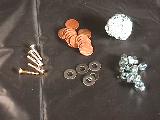
Take a wand magnet and go around the house to see what will stick to it or feel like it is attracted to it. Keep a list of the items you tried, and if the attraction was strong, weak, or none. Then try to figure out why.
Metals
Try especially different types of metals, for example:
iron and steel (nails, screws and nuts)
stainless steel (special hardware, some kitchen sinks, most everyday forks and spoons)
brass (special screws, kick-plates on front doors)
zinc (battery case)
copper (old pennies, copper pipes)
bronze (marine bell)
aluminum (foil)
silver (expensive silverware, some jewelry)
gold (wedding rings, grandma's teeth)
mercury (thermometer - no need to break the thermometer to do the test)
nickel (some coins, US nickels are made of 75% copper!, try Canadian nickels)
tungsten (filament in light bulb)
magnesium (from a science supply store, used in a ribbon form for burning in air, or from a hardware store that carries magnesium floats for working with concrete)
coins from several countries (try Canada, England, China, Japan, Germany)
Magnetism

Magnets are very common items in the workplace and household. Uses of magnets range from holding pictures on the refrigerator to causing torque in electric motors. Most people are familiar with the general properties of magnets but are less familiar with the source of magnetism. The traditional concept of magnetism centers around the magnetic field and what is know as a dipole. The term "magnetic field" simply describes a volume of space where there is a change in energy within that volume. This change in energy can be detected and measured. The location where a magnetic field can be detected exiting or entering a material is called a magnetic pole. Magnetic poles have never been detected in isolation but always occur in pairs, hence the name dipole. Therefore, a dipole is an object that has a magnetic pole on one end and a second, equal but opposite, magnetic pole on the other.
A bar magnet can be considered a dipole with a north pole at one end and south pole at the other. A magnetic field can be measured leaving the dipole at the north pole and returning the magnet at the south pole. If a magnet is cut in two, two magnets or dipoles are created out of one. This sectioning and creation of dipoles can continue to the atomic level. Therefore, the source of magnetism lies in the basic building block of all matter...the atom.
Monday, 12 May 2008
MESSAGE FOR CLASS VI STUDENTS
Hope you have enjoyed the blog and downloaded the puzzle.It is going to give you a different experience of handling your hoidays home work.You are another step towards the e learning.
BEST OF LUCK TO ALL!
HAPPY HOLIDAYS!
Savita Dhutti
BEST OF LUCK TO ALL!
HAPPY HOLIDAYS!
Savita Dhutti
Subscribe to:
Posts (Atom)